
Apart from pork , eggs are an important part of many typical meals for today: the Fatty Thursday, first Carnival day. Omelette, eggs, egg sausages… that are consumed not only today but also in our daily life. However, egg consumption is a common subject of discussion among consumers. Some years ago, it was recommended to reduce their intake; later, it was demonstrated that their intake is beneficial for health; and nowadays, there is an increasing tendency to separate white from yolk for their consumption. But… who is right? It is necessary to eat eggs? Do they have positive health effects? Should we avoid consuming egg yolks? Here, we aim at providing scientific and objective answers to these questions.
First of all we have to take into account that the use of eggs, yolk or white, or several by-products, changes according to gastronomic criteria (cooking and eating specifications); dietary criteria (fat or caloric restriction is desired); technological criteria (role of the product as food ingredient); health criteria (patients following dietary restrictions). But in any case we have to differentiate comments and/or recommendations raised for special population groups than those raised for the general population.
Which nutrients are supplied by eggs?
The egg has a very particular structure, constituted by two parts that are easily separable and have very different compositions: the yolk (1/3 of the weight) and the white (2/3). The use of the whole egg is the first option, but in the different cooking preparations and recipes, as well as in industrial uses, yolk and white are separated and treated separately mostly due to technological reasons.
For nutritional reasons is interesting to have a look to the particular composition of yolk and white, separately. This can provide useful information to clarify aspects that have been confusing for consumers. The table below shows the intakes of energy and several nutrients and cholesterol that can be reached by consuming an egg of mean size (50 g). Data are shown separately for white and yolk, so it is easier to differentiate which of both egg parts is the main supplier of each nutrient.
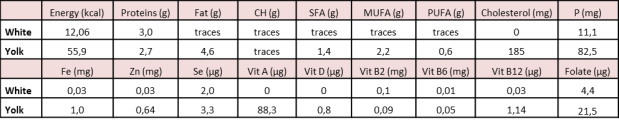 g (grams); µg (micrograms); CH (carbohydrates); SFA (saturated fatty acids); MUFA (monounsaturated fatty acids); PUFA (polyunsaturated fatty acids); P (phosphorus); Fe (iron); Zn (zinc); Se (selenium) ;
The egg white:
- Is almost only constituted by water (88%) and proteins
- it has a null content of fat (cholesterol and unsaturated fatty acids) and carbohydrates.
- Supplies a low amount of mineral elements and vitamins
The egg yolk:
- Contains a 55% of water
- Provides proteins in a similar amount than the egg white
- For this reason, the egg yolk is much more concentrated in mineral elements, vitamins and cholesterol
- Provides a substantial amount of fat, which is mainly unsaturated.
Egg yolk or white? Is there a “bad guy”?
Thus, egg white provides a lower amount of mineral elements and vitamins, cholesterol and polyunsaturated fatty acids, that are essential nutrients for humans. In contrast, yolk supplies a similar amount of proteins than white, but it also supplies a significant amount of fat. However, this fat is mainly unsaturated (66% AGMI+AGPI), with a lower proportion of saturated fat (33%). The yolk supply of iron, zinc, selenium, folate and vitamins A, D and B12 is also relevant according to the daily intake recommendations. Summarising, the yolk constitutes a good nutrient concentrate, not only for proteins but also for several micronutrients, giving to this product an important role in our diet. In contrast, the egg white constitutes a good supply of protein but not for the rest of nutrients.
So, what is better to eat? Whole eggs? Egg yolk? Egg white?
The egg is one of the best examples regarding the changes occurring in some foods’ consumption when certain dietary recommendations are published by national or international institutions. Recommendations of lower egg consumption were mainly introduced in the 70-80s, according to several studies that found relationships between a higher cholesterol intake with a higher incidence of hypercholesterolemia and cardiovascular disease. This provoked a quick decrease in the rate of egg consumption in many countries. In spite of the new studies published from the last 80s, that report data confirming that cholesterol intake does not induce hypercholesterolemia when the diet contains adequate intakes of unsaturated fat, egg consumption did not start to raise again until 2000, but a very low rate. (See recommended references).
From all these data we can make the following 10 statements:
1-The consumption of an egg does not imply a high caloric intake. Moreover, it is a quite well balanced product by a predominant presence of protein and a fat supply based mainly on unsaturated fatty acids.
2-Summarising, a portion of 2 mean size eggs would cover the following daily intake recommendations: 6% energy, 20% protein, 12% vit A and D, 30% vit B2, 16% vit B12, 12% vit A, D and folate, 8% iron and 34% selenium.
3-These values support the fact that egg will always be a basic food in our diet, according to its wide coverage of nutrient requirements. The consumption of isolated white is only recommendable in certain cases, taking always into account that a systematic refuse of yolk lead to a lower coverage of our micronutrient supply.
4-The most negative issue related to egg consumption is its high content of cholesterol in the yolk. However, although some decades ago a higher intake of cholesterol was directly related to higher levels of plasma cholesterol, more recent studies demonstrate that other dietary factors (i.e. saturated fats) have a more relevant effect, and that a frequent consumption of eggs did not affect plasma cholesterol in healthy humans.
5-It should be avoided a systematic refuse of yolk and the consumption of white alone for healthy people, that they do not show obesity, hypercholesterolemia or other pathologies demanding certain dietary restrictions.
6-For these people, a moderate consumption of whole eggs could be recommended, although scientific evidences show that even people suffering from these pathologies can eat a variable amount of eggs per week. A complementary strategy could be the “dilution” of the egg with and additional white.
7-People having specific pathologies, and submitted to specific dietary restrictions should always follow the egg consumption pattern established by the doctor or nutritionist.
8-It makes sense for sport people, particularly body-builders, to introduce egg white in their daily diet. But this should be strictly considered as a protein supplement.
9-A total restriction of yolk consumption represents a loss of many micronutrients that are also relevant for covering sport people requirements.
10-So, enjoy a very happy Fatty Thursday eating eggs!
By Dr Rafael Codony
To know something more….
 LiBiFOOD blog