Our article
Oxidative stability of a heme iron-fortified bakery product: Effectiveness of ascorbyl palmitate and co-spray-drying of heme iron with calcium caseinate
 by Mercedes Alemán, Ricard Bou, Alba Tres, Javier Polo, Rafael Codony, Francesc Guardiola
Food Chemistry, 2016, 196: 567–576.
DOI: 10.1016/j.foodchem.2015.09.031
Iron deficiency is one of the most common health issues in the world, mainly affecting infants, children and women. One of the intervention strategies currently used to tackle this problem is food fortification. As children are the population group with the highest incidence, in order to achieve a successful targeted fortification program, it is important to select a daily component of the child’s diet, such as cookies or pastries.
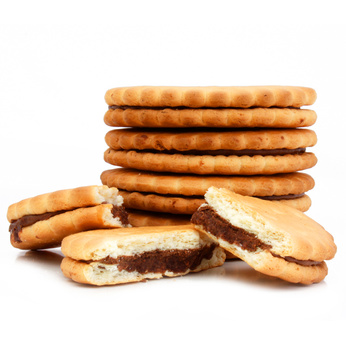 In this work, included in our research line “Oxidation, stability and food quality” we deal with a new ingredient for food iron fortification. We present a model for iron fortification in food products consisting of a sandwich-type cookie filled with a heme iron fortified chocolate cream. This food product has been selected because it could be easily introduced into a child diet and heme iron was selected because its bioavailability is higher than that of inorganic iron. However, heme iron promotes oxidation, as other iron forms. In this study we combine the addition of an antioxidant, such as ascorbyl palmitate, with the co-spray-drying of the heme iron with calcium caseinate to prevent oxidation. Both strategies proved to be effective in previous studies in palm oil fortified with heme iron.
Oxidation development and sensory acceptability were monitored in the cookies during one-year of storage at room temperature in the dark. The addition of ascorbyl palmitate protected from oxidation and from tocopherols and tocotrienols loss during cookies preparation. In general, ascorbyl palmitate, either alone or in combination with the co-spray-dried heme iron, prevented primary oxidation and hexanal formation during storage. The combination of both strategies (ascorbyl palmitate addition and co-spray-drying of the heme iron) seems to be the most suitable way to achieve oxidative stability and sensory acceptability of sandwich-type cookies fortified with heme iron.
The journal offers it for free until November 20th, 2015. Click HERE to get it!!
This study was conducted in collaboration with APC Europe and received financial support from the EVALXARTA (Xarxa de Referència en Tecnologia dels Aliments de la Generalitat de Catalunya) programme. In part, this study was made possible by the award of a fellowship grant from the Government of Navarra to Mercedes Alemán.



 LiBiFOOD blog