Science for you

Enjoy summer drinking tiger nut milk

Tiger nut milk (horchata in Spanish) is a nutritious, refreshing and very healthy product that is obtained from the tigernut, a tuber that was introduced by the Arabs in the 8th century. It is the Mediterranean drink par excellence, being high energetic, and it does not contain alcohol, caffeine, lactose or fructose and has a low sodium content. Thus, it is an ideal drink for the whole family, including children, and especially in substitution of carbonated and sweetened beverages.

  • Tiger nut milk composition

Tiger nut milk has a high content of water and carbohydrates and soluble fiber, and also contains proteins and fats, which are mainly monounsaturated fatty acids and it does not contain cholesterol. In addition, it provides vitamins and it is rich in minerals, such as potassium, calcium, phosphorus, magnesium and zinc (more information in this link).

Because of its composition, tiger nut milk is a drink with many healthy properties, since it has been described that can contribute to a good status of the cardiovascular, immune and  gastrointestinal systems. In this sense, and because of its soluble fiber content, it is considered a drink with prebiotic properties.

  • What is a prebiotic?

A prebiotic is defined as a component of the diet, essentially non-starch polysaccharides and non-digestible oligosaccharides, which is fermented selectively and it produces specific changes in the composition and / or activity of the intestinal microbiota, mainly bifidobacteria and lactobacilli, thus giving beneficial health effects (for information in this link).

One of our research lines focuses on several related bioactive compounds such as prebiotics, intestinal health indicators.
flora batterica intestinale

  • What are the benefits of a healthy microbiota?

The intestinal microbiota digests components of the diet that provide essential nutrients such as vitamins and amino acids; generates short chain fatty acids that inhibit the growth of pathogens and are a source of energy for enterocytes; competes with pathogens for space and nutrients; and improves intestinal barrier function because  stimulates the production of mucus and antimicrobial compounds that regulate epithelial permeability and modulate the immune response (more information available following this link).  

Thus, prebiotics contribute to intestinal health and can therefore help to prevent and treat certain diseases of the digestive system, such as diarrhea, an alteration that is very frequent in summer. In addition, there are studies that report that they can have positive effects on certain systemic diseases such as obesity or anxiety.

And with this fresh recommendation, the LIBIFOOD team wishes you happy summer holidays!!

Article deposited in the UB Digital Deposit. Please, use this identifier to cite it: http://hdl.handle.net/2445/120278
By Ruth Ferrer, PhD , Alba Tres, PhD and Raquel Martin, PhD
 

Re-esterified oils as new feed ingredients for pigs

Our article

“Re-esterified oils from palm acid oil do not alter pork fatty acid composition” 

by Tres A, Muzofa FM, Vilarrasa E, Guardiola F and Codony R

has been published by the European Journal of Lipid Science and Technology, 2015, 117: 1406-1416. DOI: 10.1002/ejlt.201400544

Graphical abstract_v2.png

This research article is a part of our project on the “Valorization of fat by-products as animal feed ingredients” that we are carrying out within our research line “Fats in animal feeding”.

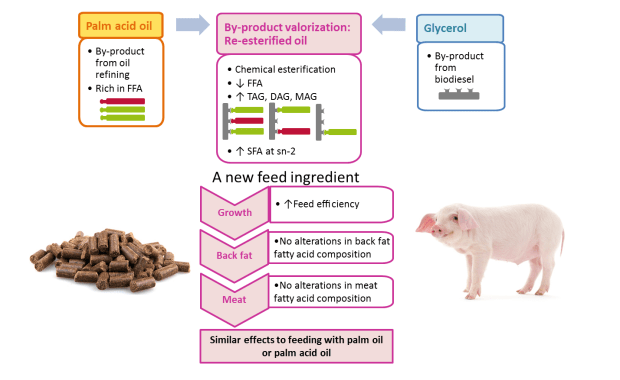
Acid oils are by-products of the food industry. They could be re-utilized as feed ingredients but their free fatty acid content is usually high. High free fatty acid contents in diets have been related to low digestibility values when used in feed. New fat products have been developed by their chemical esterification with glycerol (a by-product from biodiesel industry). Here, we have verified that these re-esterified products would not alter pork fatty acid composition with respect to the use of native
palm oil. Since results on productive parameters showed that they might increase feed efficiency and digestibility, overall the results support the re-utilization of these fat by-products in feed, alternative to the use of native palm oil or palm acid oil, provided that the benefits of the increase in feed efficiency counteract the cost of the esterification process.

The article can be downloaded HERE.

This project has been a collaboration of our research group and the Animal Science Department of the UAB, and the company SILO S.p.a (Florence, Italy). This work was financially supported by the Ministerio de
Economıa y Competitividad of the Spanish Government (Project AGL2010-22008-C02 and CTQ2012-32436), a pre-doctoral research grant from the Generalitat de Catalunya (Ref. 2012FI_B 00406), and post-doctoral research contracts from the Generalitat de Catalunya and the Marie Curie COFUND EU through the Beatriu de Pinos Post-doctoral Program (Ref. 2011BP_B 00113) and from the Juan de la Cierva program of the Ministerio de Economıa y Competitividad of the Spanish Government (ref JCI-2012-13412). We are also grateful to Enric Esteve-Garcia and the IRTA-Mas de Bover (Constantı, Spain) for the experimental farm facilities.

logo_home_nouINSAXaRTA    ministerio economia españa agauremblema_mariecurie

New published research article!

Our article

“Vegetable re-esterified oils in diets for rainbow trout: effects on fatty acid digestibility” 

by C Trullas, R Fontanillas, A Tres and R Sala,

has been published by the journal Aquaculture 2015, 444: 28-35. DOI: 10.1016/j.aquaculture.2015.03.018

This research article is a part of our project on the “Valorization of fat by-products as animal feed ingredients” that we are carrying out within our research line “Fats in animal feeding”. 

Concretely, here we are valorizing acid oils (by-products from refining of edible oils) as feed ingredients. However, their absorption by the animals (digestibility) is usually low because of their high free fatty acid content that are poorly absorbed. Indeed, digestibility is even lower when they are originated from saturated fats such as palm oil. In this project we deal with novel technical fats (re-esterified oils) that are produced by the chemical re-esterification of acid oils and glycerol (a by-product of the biodiesel industry) in order to reduce the free fatty acid content of acid oils. We use them as ingredients in feeds formulated for various species (chicken, pig, fish) and we evaluate their effects on digestibility, productive parameters and on the composition of animal products for human consumption (i.e. meat).

truita

Concretely, in the part of the study covered by this research article, two types of these new technical fats have been used in rainbow trout feed: one produced from palm acid oil, and a second one produced from rapeseed acid oil. The aim was to study their effects on feed digestibility in rainbow trout which is one of the most common species in aquaculture.

Aquaculture_Trullas

As it is explained in the article, re-esterified oils led to an improvement of fatty acid digestibility with respect to the use of acid oils. Digestibility values are similar to those obtained when the corresponding native oils were used (palm or rapeseed). This implies that both re-esterified oils might be used as fat ingredient in feed. But before recommending their use we are nowadays studying their effects on growth and animal metabolism, as well as on filet composition.

This project has been a collaboration of our research group and the Animal Science Department of the UAB, and the companies (Skretting ARC (Skretting Aquaculture Research Center, Stavanger, Norway) and SILO S.p.a (Florence, Italy) and is a part of the PhD Thesis of Clara Trullàs. It has been funded by the Spanish Ministry of Economy and Competitiveness (project AGL2010-22008-C02, and PhD grant BES-2011-046806), and by the post-doctoral program Beatriu de Pinós (2011BP_B 00113) of the Catalan Government and the COFUND Program of Marie Curie Actions within the 7th Framework Programme of the European Union.

UBINSAXaRTA   ministerio economia españa agaur emblema_mariecurie

Fostering the next generation of scientists!!

Today, LiBiFOOD together with the Escola Bressol el Carrilet have organized an outreach activity to introduce science to the youngest ones, the babies  (the “Ratolins”-Mice Classe 0-1 years)! Here some pics!

We have provided them with some “lab coats”, and some lab material (test tubes, erlenmeyers, volumetric flasks…), and it seems they have been having fun and have found it interesting. They have touched everything, bitten everything, played with everything, hit it against the floor, and they have even discovered by themselves how to wash everything with the brush!!!

Have we fostered some scientific vocations? Who knows, maybe today has become a small seed of great scientists, but we will have to wait a few years to see it….

Thank you “Ratolins-Mice” Class, it has been a great experience for us too!

By Alba Tres, PhD

Our new research article has been published!

Co-spray-drying of a heme iron ingredient to decrease its pro-oxidant effect in lipid-containing food

Mercedes Alemán, Ricard Bou, Javier Polo, Carmen Rodríguez, Alba Tres, Rafael Codony and Francesc Guardiola
has been published in the journal:

European Journal of Lipid Science and Technology

Read it!!!!! DOI: 10.1002/ejlt.201400377

This article describes the results from one of our studies within the project Optimization of the oxidative stability of foods enriched in iron, that we have conducted within our research area Oxidation, stability and food quality.

This study has been a collaboration between our research group and the company APC Europe S.A., and has been funded by the EVALXARTA program (Xarxa de Referència en Tecnologia dels Aliments de la Generalitat de Catalunya), and by a PhD grant awarded to Mercedes Alemán by the regional authorities of Navarra.

GA_M.AlemánAbstract:

Fortification of food products with non-heme or heme iron is a common strategy to overcome nutritional iron deficiency. Heme iron is highly bioavailable but it promotes oxidation, as do other iron forms. Palm oil is widely used in the formulation of bakery products and chocolate fillings. The work reported here aims to delay the onset of oxidation of a palm oil matrix fortified with heme iron, as a model for bakery products, through the use of ascorbyl palmitate (0 and 400 mg/kg) and the co-spray-drying of the heme iron with calcium caseinate in two ratios (heme iron concentrate:caseinate, 2:1 and 1:1, w/w). Primary (peroxide value and lipid hydroperoxide content) and secondary (p-anisidine value and hexanal content) oxidation were measured over one year of storage at room temperature in the dark. The combination of ascorbyl palmitate at 400 mg/kg and the co-spray-dried heme iron in a 1:1 ratio was the treatment that best protected iron fortified samples from oxidation during the storage time.

UBXaRTA

Hazelnuts: nutrition and health claims

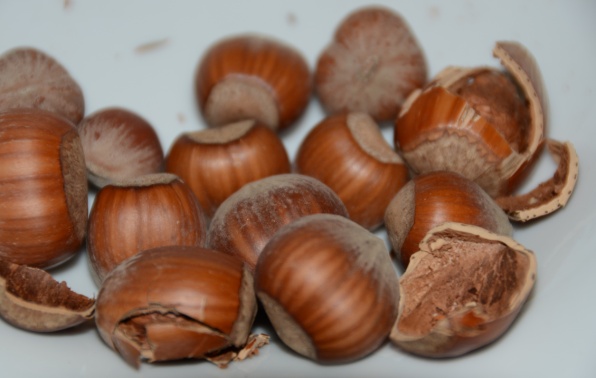
foto catala Hazelnut is a product frequently consumed as part of our Mediterranean diet. Direct consumption is common, but hazelnuts are also consumed as food ingredient in a wide variety of products (chocolates, ice-creams, cocoa & hazelnut spreads, cakes, pastries and cookies, and even in meat products) or for cooking preparation (salads, gravies, etc.). This diversity of applications is due to their particular sensory properties, very appreciated by the consumer.  But it is also important to take into account its nutritive value, fact that justifies its consumption according to international recommendations and dietary guides. Hazelnut nutritional value must be focused first on its energetic value (about 120 kcal/20 grams portion), which is mainly due to the high fat % of this nut (50-65%). However, it is also remarkable its good supply of other nutrients, such as 6% carbohydrates and 14% proteins. A 20 grams portion also provides 1,6 grams of dietary fibre, and relevant amounts of some vitamins and mineral elements: 8% vitamin B1 RDA; 7% folic acid RDA; 10% magnesium RDA (RDA, recommended dietary allowances).

But we would like to focus the attention in the fat fraction of hazelnut, since it is a major component and supplies a high amount of some fatty acids that are relevant for human nutrition and health. Hazelnuts from Catalonia (one of the major producer regions in the world) show a mean value of 60% fat, being the main part unsaturated fatty acids. From the total fatty acid fraction, 78% are monounsaturated, 14% polyunsaturated and only 7,5% saturated. According to the EU regulations (1, 2), these fatty acid values allow stating some “nutrition” and “health” claims. Possible “nutrition claims” for these hazelnuts would be: 1) High monounsaturated fat; and 2) High unsaturated fat. Accordingly, possible “Health claims” would be: Replacing saturated fats with unsaturated fats in the diet contributes to the maintenance of normal blood cholesterol levels (monounsaturated and polyunsaturated fatty acids are unsaturated fats).

As for the other plant oils and fats, there is a certain variability affecting the % total fat in the hazelnuts, as well as its fatty acid composition. This variability is mainly depending on the productive factors. Several studies carried out by our research group show that the factors related to the geographical origin of hazelnut (environmental and growing conditions) have a significant effect on hazelnut fatty acid composition while the cultivar has much less effect (3, 4). In contrast, some other components of fat, such as alpha-tocopherol (vitamin E, 30-47 mg alpha-tocopherol/100 g oil) have little variability due to the cultivar or the geographical origin. Moreover, we found that the harvest year has a huge influence in almost all these composition factors.

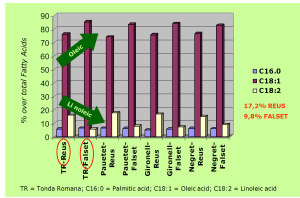
grafic avellanes engThe figure below shows the fatty acid composition (Palmitic, Oleic and Linoleic acids) of 4 hazelnut cultivars (Tonda Romana, Pauetet, Gironell and Negret). It can be seen that those growing in a mountain area (Falset) show always a higher % oleic acid and lower % linoleic acid compared to those growing in the near to the sea (Reus),regardless to the cultivar. Mean value for % linoleic acid (including the four cultivars) was 9,8% in Falset and 17,2% in Reus. In contrast, no significant differences were found between the values of the four cultivars cultivated in the same geographical area.

By Prof Rafael Codony

LITERATURE

1-COMMISSION REGULATION (EU) No 116/2010 of 9 February 2010 modifying REGULATION (EC) No 1924/2006 OF THE EUROPEAN PARLIAMENT AND OF THE COUNCIL of 20 December 2006 on nutrition and health claims made on foods.

2-COMMISSION REGULATION (EU) No 432/2012 of 16 May 2012 establishing a list of permitted health claims made on foods, other than those referring to the reduction of disease risk and to children’s development and health.

3-Parcerisa, J.; Boatella, J.; Codony, R.; Farran, A.; García, J.; López, A.; Rafecas, M.; Romero, A. Influence of variety and geographical origin on the lipid fraction of hazelnuts (Coryllus avellana L.) from Spain: I. Fatty acid composition . Food Chemistry 48, 411-414. 1993.

4-Parcerisa, J.; Boatella, J.; Codony, R.; Rafecas, M.; Castellote, A.; García, J.; López, A.; Romero, A. Comparison of fatty acid and Triacylglycerol compositions of different Hazelnut varieties (Corylus avellana L.) cultivated in Catalonia (Spain) . Journal of Agricultural and Food Chemistry  43, 13-16. 1995.

Carnival starts with the “Fatty Thursday”

Another year comes the “Fatty Thursday” (known as “Dijous Gras” in catalan, or “Jueves Lardero” in Spanish), a gastronomic day in honor of the “fat” that announces the start of carnival before Lent, a period traditionally characterized by restricting the consumption of meat products and the practice of fasting . Typical meals in Catalonia for today include Bean-Omelette, “Egg-sausage” and “Lardon Pastry”.
To celebrate this day, we propose a reflection on the consumption of animal fats and their role in our diet.

Role of animal fats in our diet

In general, animal fats are considered as unhealthy. The main result is the recommendation to minimize their consumption. As with all dietary issues, it is never a good idea to generalize and take recommendations to the extreme. It is always a good practice to improve consumer knowledge, providing tools to allow them making their own decisions. This can lead them to a more diversified diet, avoiding radical exclusion of foods with a valuable nutritional value.

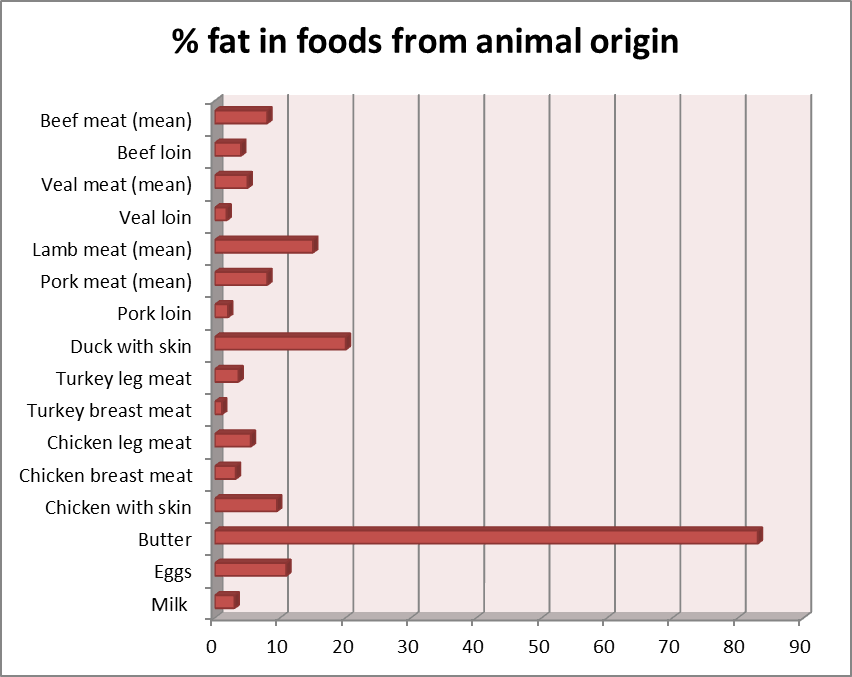
fat food animal originIf we simplify, we could say (with some exceptions) that vegetable oils have a fatty acid composition less “saturated” than animal fats which makes them healthier. But in practice this is not very useful for the consumer as few animal fats (butter being perhaps one of the few exceptions) are directly consumed. The problem is that when we reduce the consumption of animal fats, in most cases it can only be achieved if we significantly diminish or eliminate meat, poultry, eggs, milk, cheese and other dairy products from our diet. Obviously, we must set aside fish oil since it is highly unsaturated which makes its consumption highly recommendable (we will discuss this topic in future articles).

Therefore, the first overall conclusion is that the consumer must know which is the minimum percentage of total fat in foods (see chart included in this article), because a first recommendation is always to reduce the total consumption of fat in our diet.

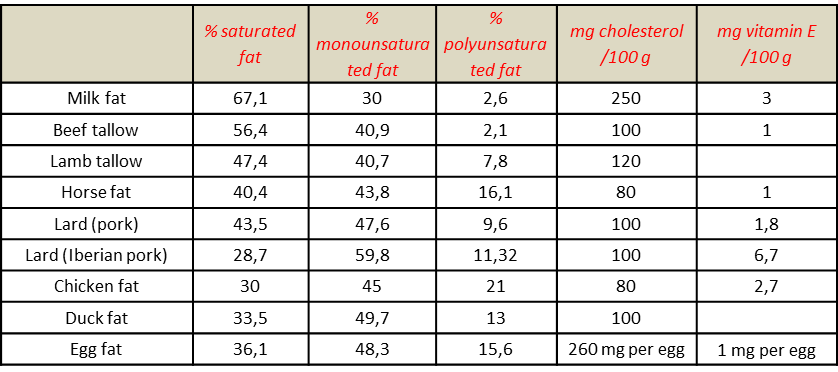
animal fat compositionBut apart of the amount of fat, it is also interesting to know the contents of the main lipid compounds of nutritional interest, mainly the % of saturated and polyunsaturated fatty acids, cholesterol or mg of vitamin A, D and E. Recently, the EU has supported this need, introducing the obligation to include basic nutritional information in food labels, although the lipid composition is not always complete. The table included in this article shows how in many cases, the composition of the fats found in animal foods includes a good proportion of monounsaturated fatty acids (pork, egg, chicken or duck) and a considerable proportion of polyunsaturated fatty acids (chicken, horse, egg). We can also see how feed can significantly change the fat composition of animal products. An example is the comparison of the proportions of saturated, mono and polyunsaturated fats in pork from animals fed compound feed or in those fed with acorns. In this respect, it is worth to mention the developments in animal feeding conducted during the lasts years such as the modification of the lipid composition in animal products, especially enriching their omega-3 fatty acid content (such as EPA, DHA). The presence of these products in the market can lead to recommendations to increase their consumption (i.e. chicken and eggs rich in omega-3).

A second nutritional reason that stands up for a more accurate recommendations on the consumption of animal fat (and thus animal products) is that decreasing their consumption might imply a reduction of the intake of high-quality protein, many vitamins (lipo- and hydro-soluble) and mineral elements such as iron and zinc.

Obviously, these comments refer to the healthy consumer and not to those that require specific dietary restrictions, either with respect to total fat consumption or to some of its components. In any case, to introduce the idea that consumers are responsible of their own diets, and that they can modulate it within some ranges is more educational and useful than setting excessive restrictions. This may facilitate that consumers follow balanced diets that are less monotonous, without feeling that they are following an imposed diet.

By Prof Rafael Codony

Oils or fats?

The term fat is a generic term used to describe any greasy substance that is not soluble in water. This includes a wide range of products, from edible oils, common in our kitchens, to lubricants for mechanical uses. From a nutritional point of view, this term must be used with care, since these two non-equivalent terms (oil, fat) are used to designate fatty substances in food and feed.

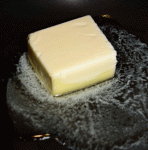
mantega fonentoliva parcialment solidThe term “fat” refers to the substances formed by 100% liposoluble materials (not water soluble materials) and that have a semi solid aspect at room temperature (20ºC), such as lard or cocoa butter. Instead, the term “oil” includes those materials which also are completely liposoluble, but are liquid at room temperature, such as olive oil or sunflower.

But it is clear that this concept is relative, since it depends on temperature. For instance, we all know that when we heat the lard in the pan, it melts and becomes liquid. In the same way,in winter in cold climates  olive oil completely or partially solidifies. This case of olive oil raises an interesting question: why olive oil is often partially solidified when cooled down? The explanation is that oils and fats are not homogeneous materials. Actually they are composed of more than 95% of what are called triglycerides (molecules that contain 3 fatty acids attached to a glycerol). But in an oil or fat there is a great variety of triglycerides, originated by the various combinations of the different fatty acids that are in the oil or fat. In a simplified way, we could say that olive oil has triglycerides containing 3 unsaturated fatty acids (such as oleic) but also triglycerides containing 1, 2 or even 3 saturated fatty acids (such as palmitic). The consequence is that the triglyceride with 3 oleic acids melts at lower temperature (or in other words, it is liquid at room temperature), while that with 3 palmitic acids melts at a higher temperature (in other words, it is semi solid at room temperature). In between there are many other combinations of fatty acids in triglycerides, each melting at a different temperature. This explains why at a certain temperature, an oil or fat can be partially liquid and partially solid. Thus, we could say that the liquid or solid aspect of an oil or fat depends on its composition in different triglycerides. This variable composition not only has an impact on the melting temperature, but also in its oxidability and nutritional value.

On the other hand, the minor fraction of oils and fats (between 1 and 5%) is usually named non-glyceridic or unsaponifiable. It contains nutritional compounds of interest, such as fat-soluble vitamins (A, D and E) and sterols (cholesterol in animal fats and oils, and various phytosterols in vegetable oils and fats). In virgin olive oil there also are some polyphenolic compounds that have shown antioxidant effects and preventive or modulating properties in atherosclerosis, diabetes and cancer among others. This has implied that the EU has authorized in its regulations (Regulation No 432/2012) a health claim for labeling or advertising of olive oils that contain polyphenols above a certain concentration (5 mg of hydroxytyrosol per 20 grams of oil).

By Rafael Codony, PhD

COMMISSION REGULATION (EU) No 432/2012 of 16 May 2012 establishing a list of permitted health claims made on foods, other than those referring to the reduction of disease risk and to children’s development and health. Official Journal of the European Union, L136/1.