LiBiFOOD News

Searching tools towards avoiding fraud in Iberian Ham!

Within our research area on food authentication, we are conducting a research project to find new analytical tools to answer the question: Is it trully Bellota Iberian ham (from pigs fed acorns)? Food products with added-value are susceptible to fraud, so having tools to detect fraud reduces fraud possibilites increasing the protection of consumers.

This week, an article describing the firsts results of this project has been published:
Authentication of Iberian dry-cured ham: New approaches by polymorphic fingerprint and ultrahigh resolution mass spectrometry

Bayes L, Tres A, Vichi S, Calvet MT, Cuevas-Diarte MA, Codony R, Boatella J, Caixach J, Ueno, S, Guardiola F.
Food Control, 2016, 60: 370-377

DOI: 10.1016/j.foodcont.2015.07.047

The journal offers it for free until October 14th, 2015. Click here to get it!!

This work presents new approaches to detect food fraud. The work deals with the problem from a multidisciplinary point of view. Thus, several crystallographic and analytical methods rarely applied to food authentication were assayed. In addition, these techniques were combined with chemometrics, using in some cases the state-of-the-art chemometric strategy in food authentication, which relies on finding a pattern in the raw analytical signal characteristic of the authentic product (fingerprint).
As a model to assay these new techniques for food authentication, we used two categories of Iberian dry-cured ham (Cebo and Bellota). With this model, the differential scanning calorimetry (DSC) thermograms of the lipid fraction provided fingerprints able to discriminate between both categories. Several crystallographic techniques (synchrotron radiation and laboratory-scale X-ray diffraction, and thermo-optical polarized microscopy) were used to characterize the crystallization, transformation and melting processes recorded by the DSC thermograms. The triacylglycerol composition determined by ultrahigh resolution mass spectrometry (UHRMS) was also able to discriminate between both categories. Thus, these determinations, in combination with chemometrics, may prove extremely useful to authenticate many foods containing high to moderate amounts of lipids, such as foods of animal origin.

New published research article!

Our article

“Vegetable re-esterified oils in diets for rainbow trout: effects on fatty acid digestibility” 

by C Trullas, R Fontanillas, A Tres and R Sala,

has been published by the journal Aquaculture 2015, 444: 28-35. DOI: 10.1016/j.aquaculture.2015.03.018

This research article is a part of our project on the “Valorization of fat by-products as animal feed ingredients” that we are carrying out within our research line “Fats in animal feeding”. 

Concretely, here we are valorizing acid oils (by-products from refining of edible oils) as feed ingredients. However, their absorption by the animals (digestibility) is usually low because of their high free fatty acid content that are poorly absorbed. Indeed, digestibility is even lower when they are originated from saturated fats such as palm oil. In this project we deal with novel technical fats (re-esterified oils) that are produced by the chemical re-esterification of acid oils and glycerol (a by-product of the biodiesel industry) in order to reduce the free fatty acid content of acid oils. We use them as ingredients in feeds formulated for various species (chicken, pig, fish) and we evaluate their effects on digestibility, productive parameters and on the composition of animal products for human consumption (i.e. meat).

truita

Concretely, in the part of the study covered by this research article, two types of these new technical fats have been used in rainbow trout feed: one produced from palm acid oil, and a second one produced from rapeseed acid oil. The aim was to study their effects on feed digestibility in rainbow trout which is one of the most common species in aquaculture.

Aquaculture_Trullas

As it is explained in the article, re-esterified oils led to an improvement of fatty acid digestibility with respect to the use of acid oils. Digestibility values are similar to those obtained when the corresponding native oils were used (palm or rapeseed). This implies that both re-esterified oils might be used as fat ingredient in feed. But before recommending their use we are nowadays studying their effects on growth and animal metabolism, as well as on filet composition.

This project has been a collaboration of our research group and the Animal Science Department of the UAB, and the companies (Skretting ARC (Skretting Aquaculture Research Center, Stavanger, Norway) and SILO S.p.a (Florence, Italy) and is a part of the PhD Thesis of Clara Trullàs. It has been funded by the Spanish Ministry of Economy and Competitiveness (project AGL2010-22008-C02, and PhD grant BES-2011-046806), and by the post-doctoral program Beatriu de Pinós (2011BP_B 00113) of the Catalan Government and the COFUND Program of Marie Curie Actions within the 7th Framework Programme of the European Union.

UBINSAXaRTA   ministerio economia españa agaur emblema_mariecurie

Fostering the next generation of scientists!!

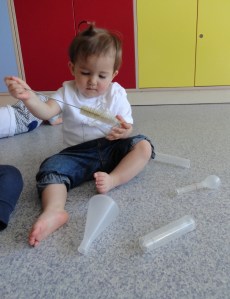
Today, LiBiFOOD together with the Escola Bressol el Carrilet have organized an outreach activity to introduce science to the youngest ones, the babies  (the “Ratolins”-Mice Classe 0-1 years)! Here some pics!

We have provided them with some “lab coats”, and some lab material (test tubes, erlenmeyers, volumetric flasks…), and it seems they have been having fun and have found it interesting. They have touched everything, bitten everything, played with everything, hit it against the floor, and they have even discovered by themselves how to wash everything with the brush!!!

Have we fostered some scientific vocations? Who knows, maybe today has become a small seed of great scientists, but we will have to wait a few years to see it….

Thank you “Ratolins-Mice” Class, it has been a great experience for us too!

By Alba Tres, PhD

Our new research article has been published!

Co-spray-drying of a heme iron ingredient to decrease its pro-oxidant effect in lipid-containing food

Mercedes Alemán, Ricard Bou, Javier Polo, Carmen Rodríguez, Alba Tres, Rafael Codony and Francesc Guardiola
has been published in the journal:

European Journal of Lipid Science and Technology

Read it!!!!! DOI: 10.1002/ejlt.201400377

This article describes the results from one of our studies within the project Optimization of the oxidative stability of foods enriched in iron, that we have conducted within our research area Oxidation, stability and food quality.

This study has been a collaboration between our research group and the company APC Europe S.A., and has been funded by the EVALXARTA program (Xarxa de Referència en Tecnologia dels Aliments de la Generalitat de Catalunya), and by a PhD grant awarded to Mercedes Alemán by the regional authorities of Navarra.

GA_M.AlemánAbstract:

Fortification of food products with non-heme or heme iron is a common strategy to overcome nutritional iron deficiency. Heme iron is highly bioavailable but it promotes oxidation, as do other iron forms. Palm oil is widely used in the formulation of bakery products and chocolate fillings. The work reported here aims to delay the onset of oxidation of a palm oil matrix fortified with heme iron, as a model for bakery products, through the use of ascorbyl palmitate (0 and 400 mg/kg) and the co-spray-drying of the heme iron with calcium caseinate in two ratios (heme iron concentrate:caseinate, 2:1 and 1:1, w/w). Primary (peroxide value and lipid hydroperoxide content) and secondary (p-anisidine value and hexanal content) oxidation were measured over one year of storage at room temperature in the dark. The combination of ascorbyl palmitate at 400 mg/kg and the co-spray-dried heme iron in a 1:1 ratio was the treatment that best protected iron fortified samples from oxidation during the storage time.

UBXaRTA

We are at…. AOCS Annual Meeting 2015!

 We are at the 106th AOCS Annual Meeting, 3-6 May 2015, in Orlando, Florida (USA)! On Wednesday morning, we at the Lipid Oxidation and Quality Session Francesc Guardiola will be presenting:

Strategies to Improve the Oxidative Stability of Bakery Products Fortified with Heme Iron

M. Alemán, R. Bou, A. Tres, R. Codony, and F. Guardiola

This presentation will cover the results of our last study of our research area Oxidation, Stability and Food quality.

Don’t miss it!

New research article on the use of novel fat products in chicken feed

This article belongs to a study on the valorization of by-products of the industry as feed ingredients.

Use of re-esterified oils, differing in their degree of saturation and molecular structure, in broiler chicken diets
E. Vilarrasa, R. Codony, E. Esteve-Garcia, yA. C. Barroeta
Poultry Science, 2015.

Re-esterified oils are a new type of fat products from the esterification of acid oils (a by-product of the oil refining industry) and glycerol. In this study we have compared the use of re-esterified oils, acid oils and native oils (from palm and soybean) as ingredients in chicken feed.  As it is described in this article (Vilarrasa et al. 2015), results show that re-esterified oils present good digestibility and production values compared to the corresponding acid and native oils. For this reason, from a productive point of view, they could be use in chicken feeding. However, before recommending their use, it is necessary to assess their effects on chicken meat composition, aspect that has also been addressed in our study and that will be published in the near future.

This study is included in our research area “Fats in animal feeding”, and has been conducted in collaboration between LiBiFOOD (University of Barcelona), IRTA and the Veterinary Faculty of the Autonomous University of Barcelona, and with the participation of the company SILO S.p.a. (Florence, Italy). It has been funded by the Ministerio de Economia y Competitividad  (Spain) (ProjectAGL2010-22008-C02-02), and a pre-doctoral research grant from the Generalitat de Catalunya (2012FI B 00406).

ministerio economia españaagaur 

We are at…. VI Workshop Probióticos, Prebióticos y Salud: Evidencia Científica

Today we are at the…..
SEPyP “VI Workshop Probióticos, Prebióticos y Salud: Evidencia Científica” (Workshop on Probiotics, Prebiotics and health: Scientific evidence” organized by the “Sociedad Española de Probióticos y Prebióticos (SEPyP) (Spanish Society for Probiotics and Prebiotics) in Oviedo (Spain) on February 5th-6th, 2015.

We are at…. Madrid Fusión 2015

madrid fusionLiBiFOOD towards synergy between science and cooking!

Today Carles Tejedor (Oilmotion, Spain) conducts the workshop “Temperaturas del Aceite” (Oil temperatures) in #MFM15 Madrid Fusión 2015 – XIII Cumbre Internacional de Gastronomía, in collaboration with LiBiFOOD and Pere Castells (Campus de l’Alimentació – Universitat de Barcelona).

Enjoy the oil !!!!

NEW CALLS FOR POST-DOCTORAL POSITIONS

POST-DOC POSITION CALL (Beatriu de Pinós Program BP-DGR 2014) 

Modality B: Grants for the recruitment of researchers to the Catalan science and technology system.

Are you willing to join us as post-doc? We are recruiting candidates to apply in the Beatriu de Pinós Program of the Generalitat de Catalunya co-financed by the European Comission through the Marie Curie-COFUND actions of the People Programme of the Seventh Framework Programme of Research and Technological Development of the European Union.  Here you can find the call including the eligibility criteria. If you are interested, please send us your CV before Jan 15th 2015.

CALL CONTRATOS POST-DOCTORALES Programa Beatriu de Pinós BP-DGR 2014

¿Quieres unirte a nuestro grupo de investigación como investigador post-doctoral? Estamos seleccionando candidatos para solicitar conjutamente un contrato posdoctoral dentro del programa Beatriu de Pinós de la Generalitat de Catalunya (cofinanciado por la Comisión Europea mediate las acciones Marie Curie COFUND del programa People del 7º Programa Marco de la UE) Aquí puedes encontrar información sobre la convocatoria y los requisitos de los candidatos. Si estás interesado, mándanos tu CV antes del 15 de Enero de 2015.

CONVOCATÒRIA CONTRACTES POST-DOCTORALS Beatriu de Pinós BP-DGR 2014

Vols fer un post-doctorat amb nosaltres? Estem buscant candidats per sol·licitar un ajut per a contractes post-doctorals Beatriu de Pinós convocats per la Generalitat de Catalunya i cofinançats per la Comissió Europea mitjançant les accions Marie Curie COFUND del programa People del 7e Programa Marc de la UE. Aquí podeu trobar les bases de la convocatòria i els requisits. Si hi esteu interessats, envieu-nos el vostre CV abans del 15 de Gener de 2015.