LiBiFOOD News

Joan Campo, scientific internship at Adisseo

foto noticia

CC BY JoanCampo

Joan Campo, one of our PhD students, is doing an internship at Adisseo France S.A.S. (Commentry, France) for a period of 5 months. This collaboration was possible thanks to  Adisseo building a new cell culture facility at Adisseo Centre of Expertise and Research in Nutrition (CERN) where he is developing his internship. At CERN, Adisseo has experimental facilities allowing the evaluation of animal nutrition which now incorporates studies with cellular cultures.

This insternship has received funding from the Fundació Universitària Agustí Pedro i Pons. 

We are at the… Food Integrity 2017

food_integrity_logo-500We are at the Food Integrity Conference 2017, in Parma, Italy (May, 9-10th, 2017). We are presenting our latest results on our research on olive oil authentication within the Autenfood project (ACCIO-Generalitat de Catalunya/FEDER, INNOAPAT RIS3CAT Community), and on the Characterization and standardization of fat by-products used in feeds.


We are at the… ESPN 2017

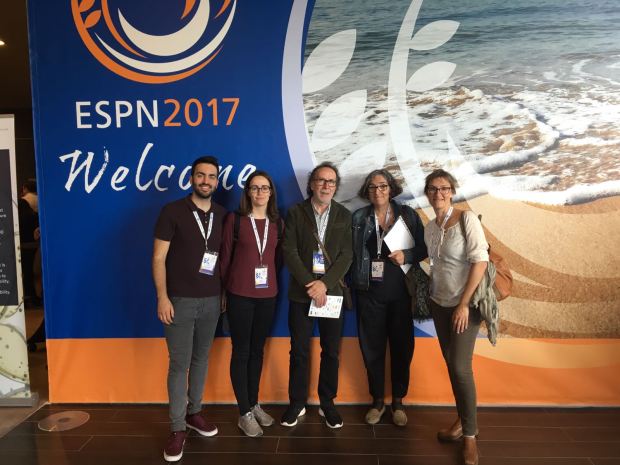
IMG-20170510-WA0014We are at the 21st European Symposium on Poultry Nutrition (8-11 May 2017, Salou, Spain). We are presenting our research on Feed raw materials, on Quality Control and nutritional quality of animal fats, and on Bioactive compounds on poultry nutrition. Meet us!

Meet us in the 15th Euro Fed Lipid congress in Uppsala!

logo_uppsala_2017

We will attend the 2017 Euro Fed Lipid Congress “Oil, Fats and Lipids: New Technologies and Applications for a Healthier Life”in Uppsala (Sweden)  to present our latests results in our animal feeding research  and on olive oil research.

Two posters will be presented on animal feeding research:

“Quality of acid oils and fatty acid distillates used in animal feeding”

“Oxidative stability of acid oils and fatty acid distillates used in animal feeding”

These results correspond to our current project on the valorization of fat by-products and co-products for animal feeding purposes.

This is a 4-year project that started on 2016, and it is funded by the Spanish Ministry of Economy, Industy and Competitiveness and the European Regional Development Fund (ERDF – FEDER)  (ref: AGL2015-64431-C2-2-R MINECO/FEDER, UE).

2011-web-economiac-63pxbanner_145x50

One poster will be presented on olive oil research:

“Sesquiterpene fingerprint for olive oil authentication: same tool, different approach”

This poster presents the first results of our research within the OLEUM project, funded by the European Union’s Horizon 2020 research and innovation programme (grant agreement No 635690).

We hope to meet you there!

We are at the…. Feed 2016: 5th International Feed Conference

Baby chicken having a mealWe are at the Feed2016: 5th International Feed Conference. Present and future challenges. that has taken place in Geel, Belgium, October 19th-20th, 2016.

We have presented ourmost recent and current research on feed ingredients and oil by-products, under the title “Oil standardization: the key step to be done to encourage the use of acid oils?” This study belongs to our reserach line on Fats in animal feeding, and the Valorization of fat by-products and co-products for animal feeding.

We are at the….CAC2016!

Aceite de olivaWe are at the CAC2016: Chemometrics in Analytical Chemistry, that is take place in Barcelona, June 6th-10th, 2016.

We have presented a part of our results on the detection of virgin olive oil adulteration with other vegetable oils. This study belongs to our reserach line on Food characterization and authentication. IMG_20160607_104510

Re-esterified oils as new feed ingredients for pigs

Our article

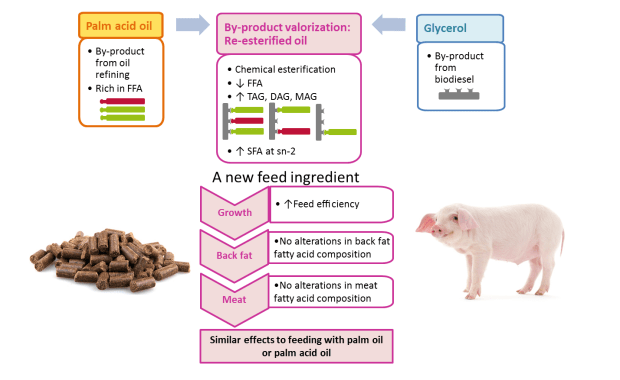
“Re-esterified oils from palm acid oil do not alter pork fatty acid composition” 

by Tres A, Muzofa FM, Vilarrasa E, Guardiola F and Codony R

has been published by the European Journal of Lipid Science and Technology, 2015, 117: 1406-1416. DOI: 10.1002/ejlt.201400544

Graphical abstract_v2.png

This research article is a part of our project on the “Valorization of fat by-products as animal feed ingredients” that we are carrying out within our research line “Fats in animal feeding”.

Acid oils are by-products of the food industry. They could be re-utilized as feed ingredients but their free fatty acid content is usually high. High free fatty acid contents in diets have been related to low digestibility values when used in feed. New fat products have been developed by their chemical esterification with glycerol (a by-product from biodiesel industry). Here, we have verified that these re-esterified products would not alter pork fatty acid composition with respect to the use of native
palm oil. Since results on productive parameters showed that they might increase feed efficiency and digestibility, overall the results support the re-utilization of these fat by-products in feed, alternative to the use of native palm oil or palm acid oil, provided that the benefits of the increase in feed efficiency counteract the cost of the esterification process.

The article can be downloaded HERE.

This project has been a collaboration of our research group and the Animal Science Department of the UAB, and the company SILO S.p.a (Florence, Italy). This work was financially supported by the Ministerio de
Economıa y Competitividad of the Spanish Government (Project AGL2010-22008-C02 and CTQ2012-32436), a pre-doctoral research grant from the Generalitat de Catalunya (Ref. 2012FI_B 00406), and post-doctoral research contracts from the Generalitat de Catalunya and the Marie Curie COFUND EU through the Beatriu de Pinos Post-doctoral Program (Ref. 2011BP_B 00113) and from the Juan de la Cierva program of the Ministerio de Economıa y Competitividad of the Spanish Government (ref JCI-2012-13412). We are also grateful to Enric Esteve-Garcia and the IRTA-Mas de Bover (Constantı, Spain) for the experimental farm facilities.

logo_home_nouINSAXaRTA    ministerio economia españa agauremblema_mariecurie

We have been at the International Symposium on Poultry Gut Health

logo

In this Symposium we have presented a communication about:

Effects of nucleotides-enriched yeast extracts on intestinal gut health of broilers  
Brufau, M.T. ; González-Jurado, N.; Pérez-Vendrell, A.M.; D’Inca, R.; Auclair, E.; Vilà, B.; Brufau, J.; Ferrer, R.; Martín-Venegas, R.

Baby chicken having a meal

Nucleotides from diet exert a nutritional role that is key for the development of tissues with a high turnover rate, such as the intestine. In periods of rapid growth, these nutrients can become conditionally essential and the dietary supplementation can benefit the development of the animal. Given the changes that occur in the intestines of broilers after hatching, the objective of the study was to investigate two indicators of intestinal health: microvilli development and goblet cell count in broilers fed 4 diets supplemented with increasing concentrations of nucleotides.

Results show that dietary supplementation of starter feed with nucleotides exerts a beneficial effect on intestinal health by increasing the absorption surface and enhancing the role of mucus in the gut barrier function

This study has been conducted within our research line  Bioactive Compounds and Health, and it is related with our line studying the influence of diet on growth and animal health.

We are at…. I Workshop INSA-UB

Workshop_anual_INSAThe Olive Oil Universe is a workshop organized at the Torribera Food Campus by researchers from INSA-UB

In this Workshop we will be presenting the results of our last project on Food authentication. The project (titled Acylglycerol fingerprinting of olive oil for fraud prevention” and leaded by Stefania Vichi PhD and Alba Tres PhD) is a preliminary study to find analytical tools to detect olive oil adulteration with seed oils. It has been funded by the FRI-2013 program of the INSA-UB.

The aim of the FRI program is to foster young INSA-UB researchers and to promote the collaboration between different research groups of the Institute.

INSA

New published research article!

Our article

Oxidative stability of a heme iron-fortified bakery product: Effectiveness of ascorbyl palmitate and co-spray-drying of heme iron with calcium caseinate
by Mercedes Alemán, Ricard Bou, Alba Tres, Javier Polo, Rafael Codony, Francesc Guardiola

Food Chemistry, 2016, 196: 567–576.

DOI: 10.1016/j.foodchem.2015.09.031

Iron deficiency is one of the most common health issues in the world, mainly affecting infants, children and women. One of the intervention strategies currently used to tackle this problem is food fortification. As children are the population group with the highest incidence, in order to achieve a successful targeted fortification program, it is important to select a daily component of the child’s diet, such as cookies or pastries.

In this work, included in our research line “Oxidation, stability and food quality” we deal with a new ingredient for food iron fortification. We present a model for iron fortification in food products consisting of a sandwich-type cookie filled with a heme iron fortified chocolate cream. This food product has been selected because it could be easily introduced into a child diet and heme iron was selected because its bioavailability is higher than that of inorganic iron. However, heme iron promotes oxidation, as other iron forms. In this study we combine the addition of an antioxidant, such as ascorbyl palmitate, with the co-spray-drying of the heme iron with calcium caseinate to prevent oxidation. Both strategies proved to be effective in previous studies in palm oil fortified with heme iron.

Oxidation development and sensory acceptability were monitored in the cookies during one-year of storage at room temperature in the dark. The addition of ascorbyl palmitate protected from oxidation and from tocopherols and tocotrienols loss during cookies preparation. In general, ascorbyl palmitate, either alone or in combination with the co-spray-dried heme iron, prevented primary oxidation and hexanal formation during storage. The combination of both strategies (ascorbyl palmitate addition and co-spray-drying of the heme iron) seems to be the most suitable way to achieve oxidative stability and sensory acceptability of sandwich-type cookies fortified with heme iron.

The journal offers it for free until November 20th, 2015. Click HERE to get it!!

This study was conducted in collaboration with APC Europe and received financial support from the EVALXARTA (Xarxa de Referència en Tecnologia dels Aliments de la Generalitat de Catalunya) programme. In part, this study was made possible by the award of a fellowship grant from the Government of Navarra to Mercedes Alemán.

XaRTA