The term fat is a generic term used to describe any greasy substance that is not soluble in water. This includes a wide range of products, from edible oils, common in our kitchens, to lubricants for mechanical uses. From a nutritional point of view, this term must be used with care, since these two non-equivalent terms (oil, fat) are used to designate fatty substances in food and feed.
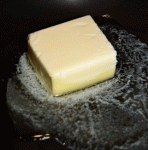
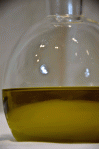 The term “fat” refers to the substances formed by 100% liposoluble materials (not water soluble materials) and that have a semi solid aspect at room temperature (20ºC), such as lard or cocoa butter. Instead, the term “oil” includes those materials which also are completely liposoluble, but are liquid at room temperature, such as olive oil or sunflower.
But it is clear that this concept is relative, since it depends on temperature. For instance, we all know that when we heat the lard in the pan, it melts and becomes liquid. In the same way,in winter in cold climates olive oil completely or partially solidifies. This case of olive oil raises an interesting question: why olive oil is often partially solidified when cooled down? The explanation is that oils and fats are not homogeneous materials. Actually they are composed of more than 95% of what are called triglycerides (molecules that contain 3 fatty acids attached to a glycerol). But in an oil or fat there is a great variety of triglycerides, originated by the various combinations of the different fatty acids that are in the oil or fat. In a simplified way, we could say that olive oil has triglycerides containing 3 unsaturated fatty acids (such as oleic) but also triglycerides containing 1, 2 or even 3 saturated fatty acids (such as palmitic). The consequence is that the triglyceride with 3 oleic acids melts at lower temperature (or in other words, it is liquid at room temperature), while that with 3 palmitic acids melts at a higher temperature (in other words, it is semi solid at room temperature). In between there are many other combinations of fatty acids in triglycerides, each melting at a different temperature. This explains why at a certain temperature, an oil or fat can be partially liquid and partially solid. Thus, we could say that the liquid or solid aspect of an oil or fat depends on its composition in different triglycerides. This variable composition not only has an impact on the melting temperature, but also in its oxidability and nutritional value.
On the other hand, the minor fraction of oils and fats (between 1 and 5%) is usually named non-glyceridic or unsaponifiable. It contains nutritional compounds of interest, such as fat-soluble vitamins (A, D and E) and sterols (cholesterol in animal fats and oils, and various phytosterols in vegetable oils and fats). In virgin olive oil there also are some polyphenolic compounds that have shown antioxidant effects and preventive or modulating properties in atherosclerosis, diabetes and cancer among others. This has implied that the EU has authorized in its regulations (Regulation No 432/2012) a health claim for labeling or advertising of olive oils that contain polyphenols above a certain concentration (5 mg of hydroxytyrosol per 20 grams of oil).
By Rafael Codony, PhD
COMMISSION REGULATION (EU) No 432/2012 of 16 May 2012 establishing a list of permitted health claims made on foods, other than those referring to the reduction of disease risk and to children’s development and health. Official Journal of the European Union, L136/1.
M'agrada S'està carregant...


 We are at the Food Integrity Conference 2017, in Parma, Italy (May, 9-10th, 2017). We are presenting our latest results on our
  We are at the 21st European Symposium on Poultry Nutrition (8-11 May 2017, Salou, Spain). We are presenting our research on


 We are at the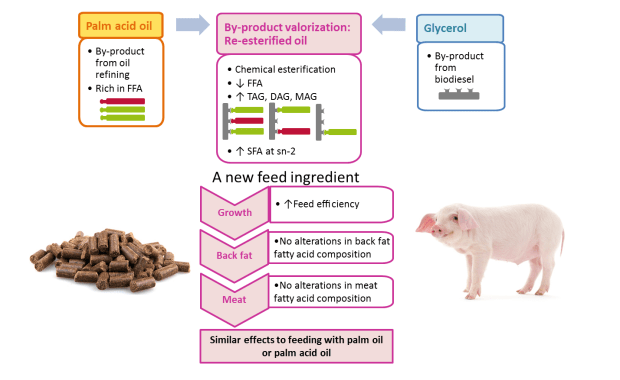









 This article belongs to a study on the valorization of by-products of the industry as feed ingredients.
 LiBiFOOD blog