Autor: libifood

Fatty thursday, the egg day!

Eggs

Apart from pork , eggs are an important part of many typical meals for today: the Fatty Thursday, first Carnival day. Omelette, eggs, egg sausages… that are consumed not only today but also in our daily life. However, egg consumption is a common subject of discussion among consumers. Some years ago, it was recommended to reduce their intake; later, it was demonstrated that their intake is beneficial for health; and nowadays, there is an increasing tendency to separate white from yolk for their consumption. But… who is right? It is necessary to eat eggs? Do they have positive health effects? Should we avoid consuming egg yolks? Here, we aim at providing scientific and objective answers to these questions.

First of all we have to take into account that the use of eggs, yolk or white, or several by-products, changes according to gastronomic criteria (cooking and eating specifications); dietary criteria (fat or caloric restriction is desired); technological criteria (role of the product as food ingredient); health criteria (patients following dietary restrictions). But in any case we have to differentiate comments and/or recommendations raised for special population groups than those raised for the general population.

Which nutrients are supplied by eggs?

The egg has a very particular structure, constituted by two parts that are easily separable and have very different compositions: the yolk (1/3 of the weight) and the white (2/3). The use of the whole egg is the first option, but in the different cooking preparations and recipes, as well as in industrial uses, yolk and white are separated and treated separately mostly due to technological reasons.

For nutritional reasons is interesting to have a look to the particular composition of yolk and white, separately. This can provide useful information to clarify aspects that have been confusing for consumers. The table below shows the intakes of energy and several nutrients and cholesterol that can be reached by consuming an egg of mean size (50 g). Data are shown separately for white and yolk, so it is easier to differentiate which of both egg parts is the main supplier of each nutrient.
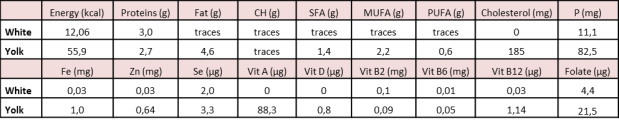
Yolk and white compositiong (grams); µg (micrograms); CH (carbohydrates); SFA (saturated fatty acids); MUFA (monounsaturated fatty acids); PUFA (polyunsaturated fatty acids); P (phosphorus);  Fe (iron); Zn (zinc); Se (selenium) ;

The egg white:

  • Is almost only constituted by water (88%) and proteins
  • it has a null content of fat (cholesterol and unsaturated fatty acids) and carbohydrates.
  • Supplies a low amount of mineral elements and vitamins

The egg yolk:

  • Contains a 55% of water
  • Provides proteins in a similar amount than the egg white
  • For this reason, the egg yolk is much more concentrated in mineral elements, vitamins and cholesterol
  • Provides a substantial amount of fat, which is mainly unsaturated.

Egg yolk or white? Is there a “bad guy”?

Thus, egg white provides a lower amount of mineral elements and vitamins, cholesterol and polyunsaturated fatty acids, that are essential nutrients for humans. In contrast, yolk supplies a similar amount of proteins than white, but it also supplies a significant amount of fat. However, this fat is mainly unsaturated (66% AGMI+AGPI), with a lower proportion of saturated fat (33%). The yolk supply of iron, zinc, selenium, folate and vitamins A, D and B12 is also relevant according to the daily intake recommendations. Summarising, the yolk constitutes a good nutrient concentrate, not only for proteins but also for several micronutrients, giving to this product an important role in our diet. In contrast, the egg white constitutes a good supply of protein but not for the rest of nutrients.

So, what is better to eat? Whole eggs? Egg yolk? Egg white?

The egg is one of the best examples regarding the changes occurring in some foods’ consumption when certain dietary recommendations are published by national or international institutions. Recommendations of lower egg consumption were mainly introduced in the 70-80s, according to several studies that found relationships between a higher cholesterol intake with a higher incidence of hypercholesterolemia and cardiovascular disease. This provoked a quick decrease in the rate of egg consumption in many countries. In spite of the new studies published from the last 80s, that report data confirming that cholesterol intake does not induce hypercholesterolemia when the diet contains adequate intakes of unsaturated fat, egg consumption did not start to raise again until 2000, but a very low rate. (See recommended references).

From all these data we can make the following 10 statements:

1-The consumption of an egg does not imply a high caloric intake. Moreover, it is a quite well balanced product by a predominant presence of protein and a fat supply based mainly on unsaturated fatty acids.

2-Summarising, a portion of 2 mean size eggs would cover the following daily intake recommendations: 6% energy, 20% protein, 12% vit A and D, 30% vit B2, 16% vit B12, 12% vit A, D and folate, 8% iron and 34% selenium.

3-These values support the fact that egg will always be a basic food in our diet, according to its wide coverage of nutrient requirements. The consumption of isolated white is only recommendable in certain cases, taking always into account that a systematic refuse of yolk lead to a lower coverage of our micronutrient supply.

4-The most negative issue related to egg consumption is its high content of cholesterol in the yolk. However, although some decades ago a higher intake of cholesterol was directly related to higher levels of plasma cholesterol, more recent studies demonstrate that other dietary factors (i.e. saturated fats) have a more relevant effect, and that a frequent consumption of eggs did not affect plasma cholesterol in healthy humans.

5-It should be avoided a systematic refuse of yolk and the consumption of white alone for healthy people, that they do not show obesity, hypercholesterolemia or other pathologies demanding certain dietary restrictions.

6-For these people, a moderate consumption of whole eggs could be recommended, although scientific evidences show that even people suffering from these pathologies can eat a variable amount of eggs per week. A complementary strategy could be the “dilution” of the egg with and additional white.

7-People having specific pathologies, and submitted to specific dietary restrictions should always follow the egg consumption pattern established by the doctor or nutritionist.

8-It makes sense for sport people, particularly body-builders, to introduce egg white in their daily diet. But this should be strictly considered as a protein supplement.

9-A total restriction of yolk consumption represents a loss of many micronutrients that are also relevant for covering sport people requirements.

10-So, enjoy a very happy Fatty Thursday eating eggs!

By Dr Rafael Codony

To know something more….
Ingesta de huevo y factores de riesgo cardiovascular en adolescentes; papel de la actividad física. Estudio HELENA. A. Soriano-Maldonado, M. Cuenca-García, L. A. Moreno, M. González-Gross, C. Leclercq,O. Androutsos, E. J. Guerra-Hernández, M. J. Castillo y J. R. Ruiz. Nutr Hosp. 2013. 28(3):868-877.
A prospective study of egg consumption and risk of cardiovascular disease in men and women.Hu, F.B., Stampfer, M.J., Rimm, E.B., Manson, J.E., Ascherio, A., Colditz, G.A., Rosner, B.A., Spiegelman, D., Speizer, F.E., Sacks, F.R., Hennekens, C.H., Willet, W.C. 1999.  JAMA, 281: 1387-1394.
The impact of egg limitations on coronary heart disease risk: do the numbers up? McNamara, D.J. 2000. J. Am. Coll. Ntr. 19 (5): 540S-548S.
Congruence of individual responsiveness to dietary cholesterol and to saturated fat in humans.Katan, M.B., Berns, M.A.M., Glatz, J.F.C., Knuiman, J.T, Nobels, A. y De Vries, J.H.M., 1988. J. Lipid Res., 29: 883-892.

Re-esterified oils as new feed ingredients for pigs

Our article

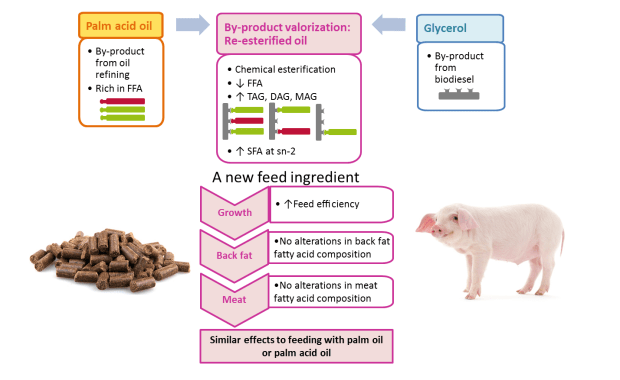
“Re-esterified oils from palm acid oil do not alter pork fatty acid composition” 

by Tres A, Muzofa FM, Vilarrasa E, Guardiola F and Codony R

has been published by the European Journal of Lipid Science and Technology, 2015, 117: 1406-1416. DOI: 10.1002/ejlt.201400544

Graphical abstract_v2.png

This research article is a part of our project on the “Valorization of fat by-products as animal feed ingredients” that we are carrying out within our research line “Fats in animal feeding”.

Acid oils are by-products of the food industry. They could be re-utilized as feed ingredients but their free fatty acid content is usually high. High free fatty acid contents in diets have been related to low digestibility values when used in feed. New fat products have been developed by their chemical esterification with glycerol (a by-product from biodiesel industry). Here, we have verified that these re-esterified products would not alter pork fatty acid composition with respect to the use of native
palm oil. Since results on productive parameters showed that they might increase feed efficiency and digestibility, overall the results support the re-utilization of these fat by-products in feed, alternative to the use of native palm oil or palm acid oil, provided that the benefits of the increase in feed efficiency counteract the cost of the esterification process.

The article can be downloaded HERE.

This project has been a collaboration of our research group and the Animal Science Department of the UAB, and the company SILO S.p.a (Florence, Italy). This work was financially supported by the Ministerio de
Economıa y Competitividad of the Spanish Government (Project AGL2010-22008-C02 and CTQ2012-32436), a pre-doctoral research grant from the Generalitat de Catalunya (Ref. 2012FI_B 00406), and post-doctoral research contracts from the Generalitat de Catalunya and the Marie Curie COFUND EU through the Beatriu de Pinos Post-doctoral Program (Ref. 2011BP_B 00113) and from the Juan de la Cierva program of the Ministerio de Economıa y Competitividad of the Spanish Government (ref JCI-2012-13412). We are also grateful to Enric Esteve-Garcia and the IRTA-Mas de Bover (Constantı, Spain) for the experimental farm facilities.

logo_home_nouINSAXaRTA    ministerio economia españa agauremblema_mariecurie

We have been at the International Symposium on Poultry Gut Health

logo

In this Symposium we have presented a communication about:

Effects of nucleotides-enriched yeast extracts on intestinal gut health of broilers  
Brufau, M.T. ; González-Jurado, N.; Pérez-Vendrell, A.M.; D’Inca, R.; Auclair, E.; Vilà, B.; Brufau, J.; Ferrer, R.; Martín-Venegas, R.

Baby chicken having a meal

Nucleotides from diet exert a nutritional role that is key for the development of tissues with a high turnover rate, such as the intestine. In periods of rapid growth, these nutrients can become conditionally essential and the dietary supplementation can benefit the development of the animal. Given the changes that occur in the intestines of broilers after hatching, the objective of the study was to investigate two indicators of intestinal health: microvilli development and goblet cell count in broilers fed 4 diets supplemented with increasing concentrations of nucleotides.

Results show that dietary supplementation of starter feed with nucleotides exerts a beneficial effect on intestinal health by increasing the absorption surface and enhancing the role of mucus in the gut barrier function

This study has been conducted within our research line  Bioactive Compounds and Health, and it is related with our line studying the influence of diet on growth and animal health.

New call for postdoctoral positions

POST-DOC POSITION CALL (Juan de la Cierva Programs) 

Are you willing to join us as post-doc? We are recruiting candidates to apply in the Juan de la Cierva-incorporación and Juan de la Cierva-formación Programs of the Spanish Ministry of Economy and Competitiveness.  Here you can find the call rules including the eligibility criteria:

 Juan de la Cierva – formación:

-PhD title obtained between Jan 1st, 2014 and Dec 31st, 2015.

– Main evaluation criteria: Scientific contributions and international experience.

Juan de la Cierva – incorporación:

-PhD title obtained between Jan 1st, 2011 and Dec 31st, 2013.

– Main evaluation criteria: Scientific contributions and international experience.

Ifyou are interested, pleasesend us your CV before Jan 25th 2016.

New PhD positions (funded by FPU program)

Would you like to become a PhD researcher? Would you like to join our research team? The fats and oils reaserch field has many gaps to solve!

We selecting 2 candidates who are willing to apply for a PhD fellowship within the FPU program  funded by the Spanish Ministry of Educaation, Culture and Sports (4 years fellowship; starting date: September 2016).

The PhD project would be part of one of these reseach lines:

Candidate’s preferred profiles include:
Education:

  • MsC degree in Pharmacy, Food Science, Chemistry, Biology or similar, with marks above 7.5 (0-10 Spanish system scale)

Other aspects:

  • Good english level
  • Previus experience in research

Please, send us your CV, including a copy of your academic transcript of records before December 15th, 2015.


We are at…. I Workshop INSA-UB

Workshop_anual_INSAThe Olive Oil Universe is a workshop organized at the Torribera Food Campus by researchers from INSA-UB

In this Workshop we will be presenting the results of our last project on Food authentication. The project (titled Acylglycerol fingerprinting of olive oil for fraud prevention” and leaded by Stefania Vichi PhD and Alba Tres PhD) is a preliminary study to find analytical tools to detect olive oil adulteration with seed oils. It has been funded by the FRI-2013 program of the INSA-UB.

The aim of the FRI program is to foster young INSA-UB researchers and to promote the collaboration between different research groups of the Institute.

INSA

80 years ago!

Research on fats and oils has a long tradition in our Department. Two references exemplify this:

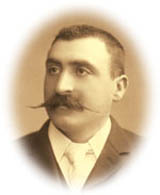
  • Ramón Casamada Mauri (1874-1936), who was Full Professor on 1911, bought a copy (that we still preserve) of the 5th Edition (1913) of “Chemical Technology and Analysis of Oils, Fats and Waxes autored by Julius Lewkowitsch (1857-1913), a referent in the fats and oils field. It is an encyclopaedic work that contains extensive information on oil composition and technology.

lewkowitch

  • The other reference is a study by Casamada entitled “Espectros de absorción en ultravioleta para la diferenciación de los aceites de oliva vírgen de los refinados [“Utraviolet absorption spectra for the differentiation of virgin and refined olive oils”] (Barcelona, Imp, Sobr. López Robert y Cia, 1935).

This shows that topics of our current research were already a concern 80 years ago, and that some of those results are still valid!

By Prof J Boatella

New published research article!

Our article

Oxidative stability of a heme iron-fortified bakery product: Effectiveness of ascorbyl palmitate and co-spray-drying of heme iron with calcium caseinate

by Mercedes Alemán, Ricard Bou, Alba Tres, Javier Polo, Rafael Codony, Francesc Guardiola

Food Chemistry, 2016, 196: 567–576.

DOI: 10.1016/j.foodchem.2015.09.031

Iron deficiency is one of the most common health issues in the world, mainly affecting infants, children and women. One of the intervention strategies currently used to tackle this problem is food fortification. As children are the population group with the highest incidence, in order to achieve a successful targeted fortification program, it is important to select a daily component of the child’s diet, such as cookies or pastries.

In this work, included in our research line “Oxidation, stability and food quality” we deal with a new ingredient for food iron fortification. We present a model for iron fortification in food products consisting of a sandwich-type cookie filled with a heme iron fortified chocolate cream. This food product has been selected because it could be easily introduced into a child diet and heme iron was selected because its bioavailability is higher than that of inorganic iron. However, heme iron promotes oxidation, as other iron forms. In this study we combine the addition of an antioxidant, such as ascorbyl palmitate, with the co-spray-drying of the heme iron with calcium caseinate to prevent oxidation. Both strategies proved to be effective in previous studies in palm oil fortified with heme iron.

Oxidation development and sensory acceptability were monitored in the cookies during one-year of storage at room temperature in the dark. The addition of ascorbyl palmitate protected from oxidation and from tocopherols and tocotrienols loss during cookies preparation. In general, ascorbyl palmitate, either alone or in combination with the co-spray-dried heme iron, prevented primary oxidation and hexanal formation during storage. The combination of both strategies (ascorbyl palmitate addition and co-spray-drying of the heme iron) seems to be the most suitable way to achieve oxidative stability and sensory acceptability of sandwich-type cookies fortified with heme iron.

The journal offers it for free until November 20th, 2015. Click HERE to get it!!

This study was conducted in collaboration with APC Europe and received financial support from the EVALXARTA (Xarxa de Referència en Tecnologia dels Aliments de la Generalitat de Catalunya) programme. In part, this study was made possible by the award of a fellowship grant from the Government of Navarra to Mercedes Alemán.

XaRTA

Searching tools towards avoiding fraud in Iberian Ham!

Within our research area on food authentication, we are conducting a research project to find new analytical tools to answer the question: Is it trully Bellota Iberian ham (from pigs fed acorns)? Food products with added-value are susceptible to fraud, so having tools to detect fraud reduces fraud possibilites increasing the protection of consumers.

This week, an article describing the firsts results of this project has been published:

Authentication of Iberian dry-cured ham: New approaches by polymorphic fingerprint and ultrahigh resolution mass spectrometry

Bayes L, Tres A, Vichi S, Calvet MT, Cuevas-Diarte MA, Codony R, Boatella J, Caixach J, Ueno, S, Guardiola F.
Food Control, 2016, 60: 370-377

DOI: 10.1016/j.foodcont.2015.07.047

The journal offers it for free until October 14th, 2015. Click here to get it!!

This work presents new approaches to detect food fraud. The work deals with the problem from a multidisciplinary point of view. Thus, several crystallographic and analytical methods rarely applied to food authentication were assayed. In addition, these techniques were combined with chemometrics, using in some cases the state-of-the-art chemometric strategy in food authentication, which relies on finding a pattern in the raw analytical signal characteristic of the authentic product (fingerprint).
As a model to assay these new techniques for food authentication, we used two categories of Iberian dry-cured ham (Cebo and Bellota). With this model, the differential scanning calorimetry (DSC) thermograms of the lipid fraction provided fingerprints able to discriminate between both categories. Several crystallographic techniques (synchrotron radiation and laboratory-scale X-ray diffraction, and thermo-optical polarized microscopy) were used to characterize the crystallization, transformation and melting processes recorded by the DSC thermograms. The triacylglycerol composition determined by ultrahigh resolution mass spectrometry (UHRMS) was also able to discriminate between both categories. Thus, these determinations, in combination with chemometrics, may prove extremely useful to authenticate many foods containing high to moderate amounts of lipids, such as foods of animal origin.