Chicken is part of our Christmas gastronomy. While we wish you a very merry Christmas, we have written a small summary of autoctonous catalan chicken breeds, in case you would like to enjoy easting one of them during Christmas! Have a nice meal and Merry Christmas!
Chicken origin
Origin – All chickens in the world come from a wild ancestor of Southeast Asia, the red hen of the jungle (Gallus gallus). Domestication, expansion and selection of breeds have led to the varieties we know today. In Catalonia, it would have arrived during the classical antiquity: the Romans used the Greek breeds for meat (they were large porters but bad breeders) and their own breeds for laying eggs. The natural and artificial selection and the introduction of genes originating in other countries have been forming, with the years, resistant and adapted animals in our environment that we consider as native.
From the 18th century, the definition and improvement of the autochthonous breeds began in Catalonia and the following races arose as the more popular: Catalana del Prat, Penedesenca and Empordanesa. In the 1950s, breeding of more productive foreign breeds (Leghorn, Rhode Island, New Hampshire, etc.) caused the regression of autochthonous breeds, but in 1974 began the recuperation of the breed of the Prat and in 1982, the recuperation of the Penedesenca and Empordanesa breeds.
Diversity of Catalan chicken breeds
El Prat chicken breed (www.pollastresdelprat.org)
Originated in Baix Llobregat. The hen is an excellent layer (pink eggshell) and chickens are very apt to make capons with very fine meat. Big-headed chickens, with a simple, rather large, 5-6-teeth crest; large and hanging beards and oblique and white ears. Long and arched peak and slate blue legs. This race has two varieties: a) tawny (fair feathers without reaching red) and b) white (plumage of white colour).
 After a process of purebred improvement, the chickens arrive to 2.2 kg (minimum required for the sacrifice) at 14-weeks of life, although the best the best age to enjoy the meat is between 15 and 18 weeks. Meat is low in fat, very fibrous and slightly pasty, and much tastier than conventional chickens. The race of el Prat has granted a Protected Geographical Indication (PGI) of the European Union with the name “Chicken and capon of El Prat”. This race responds very well to the effects of castration and capons are marketed for Christmas time (they reach 5 kg of weight at 8 months of age). The meat of the capon is distinguished from that of the chicken because it is tender and has a more pronounced taste. Tenderness is due to a higher fat content.
Penedesenca Breed (www.galldelpenedes.cat)
The hens lay eggs with the shell of a very intense brown-red colour, known as the red eggs from Vilafranca. It is a light bird with a lot of vitality. Big and broad headed chickens; simple, medium-sized crest with 5-6 teeth. Medium and hanging beards and white ears red edged. Long peak, slightly curved and strong.
This race has four varieties: a) black (plumage and legs completely black but white plants); b) quailed (chest completely black with some red feather and grey sub-plumage); c) wheat colour (very similar to the quailed variety but with white sub-plumage, and blue light slate legs) and, finally, d) barred (very similar to the quailed variety but with clear strips in all the body and white legs).
 The main attraction of the Penedesenca race is the production of dark eggs but they are also used to produce meat; in this case, the black variety (Penedesenca Negra) is the most cost-efficient since the chicken achieves 2.2 kg at 11 weeks of age. The meat is characterized by a low fat contents, tenderness and juicy. Another one of its peculiarities, is that according to the traditional agronomic practice in the area, the diet of Gall del Penedès includes grapes, offering to it unique organoleptic properties compared to chickens fed with other diets.
 Currently, the product is protected under the PGI Gall del Penedès.
Empordanesa breed (www.empordanesa.org)
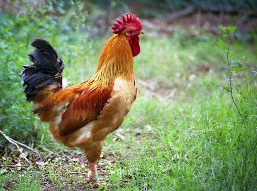
Empordanesa breed (Photo: A. i M. Francesch)
Originated from hens of the Empordà, they also lay dark eggs. The chicken can reach 2.5 kg of weight at 18 weeks of age. The rooster has a simple medium, 5-6-teeth crest; medium and rounded bears and oblique and red ears. Short and arched peak and yellow legs. This race has three varieties: a) white (white plumage): b) red (red tawny plumage with black in the neck, tail and wings and sub-plumage of cream colour) and, c) fair (fair plumage with black, blue or white in the neck, tail and wings with grey or white sub-plumage. The meat of this race is of quality, fibrous and slightly pasty.
The Prat and Empordà breeds as well as the black Penedesenca are best suited for an improvement program for the production of meat and the other varieties, with a lower consumption of feed, promise more for a program to improve the production of eggs.
Downlod our Christmas postcard!
Francesch, A. (1990) Les races de gallines catalanes: del passat cap al futur, Quaderns Agraris, 12 : 63-70.

Francesch, A. (2010). Races autòctones. Races avícoles. Dossier Tècnic (Ruralcat, Generalitat de Catalunya) 44, agost de 2010.
 LiBiFOOD blog