 Another year comes the “Fatty Thursday” (known as “Dijous Gras” in catalan, or “Jueves Lardero” in Spanish), a gastronomic day in honor of the “fat” that announces the start of carnival before Lent, a period traditionally characterized by restricting the consumption of meat products and the practice of fasting . Typical meals in Catalonia for today include Bean-Omelette, “Egg-sausage” and “Lardon Pastry”.
To celebrate this day, we propose a reflection on the consumption of animal fats and their role in our diet.
Role of animal fats in our diet
In general, animal fats are considered as unhealthy. The main result is the recommendation to minimize their consumption. As with all dietary issues, it is never a good idea to generalize and take recommendations to the extreme. It is always a good practice to improve consumer knowledge, providing tools to allow them making their own decisions. This can lead them to a more diversified diet, avoiding radical exclusion of foods with a valuable nutritional value.
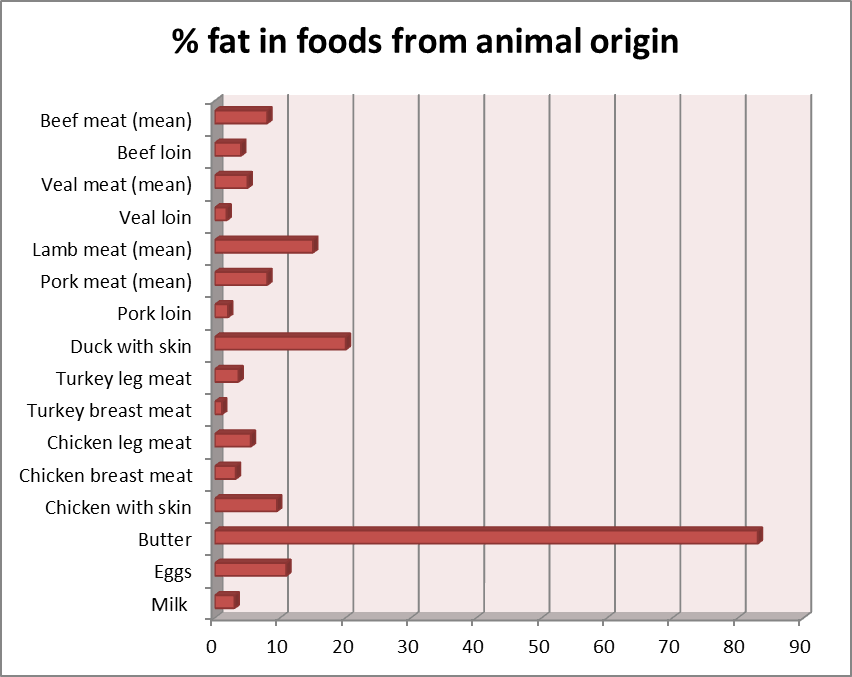 If we simplify, we could say (with some exceptions) that vegetable oils have a fatty acid composition less “saturated” than animal fats which makes them healthier. But in practice this is not very useful for the consumer as few animal fats (butter being perhaps one of the few exceptions) are directly consumed. The problem is that when we reduce the consumption of animal fats, in most cases it can only be achieved if we significantly diminish or eliminate meat, poultry, eggs, milk, cheese and other dairy products from our diet. Obviously, we must set aside fish oil since it is highly unsaturated which makes its consumption highly recommendable (we will discuss this topic in future articles).
Therefore, the first overall conclusion is that the consumer must know which is the minimum percentage of total fat in foods (see chart included in this article), because a first recommendation is always to reduce the total consumption of fat in our diet.
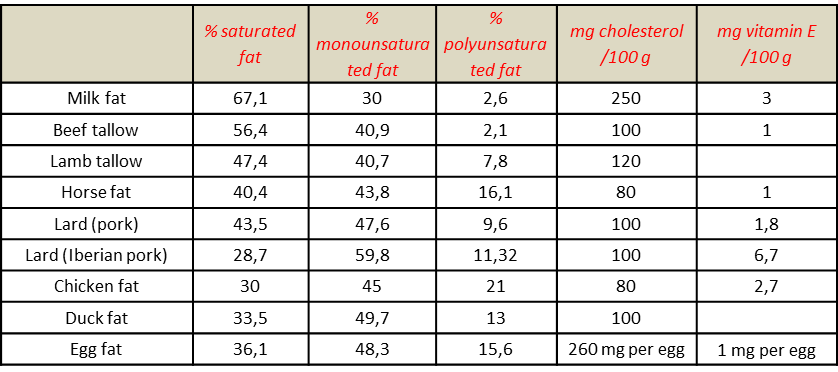 But apart of the amount of fat, it is also interesting to know the contents of the main lipid compounds of nutritional interest, mainly the % of saturated and polyunsaturated fatty acids, cholesterol or mg of vitamin A, D and E. Recently, the EU has supported this need, introducing the obligation to include basic nutritional information in food labels, although the lipid composition is not always complete. The table included in this article shows how in many cases, the composition of the fats found in animal foods includes a good proportion of monounsaturated fatty acids (pork, egg, chicken or duck) and a considerable proportion of polyunsaturated fatty acids (chicken, horse, egg). We can also see how feed can significantly change the fat composition of animal products. An example is the comparison of the proportions of saturated, mono and polyunsaturated fats in pork from animals fed compound feed or in those fed with acorns. In this respect, it is worth to mention the developments in animal feeding conducted during the lasts years such as the modification of the lipid composition in animal products, especially enriching their omega-3 fatty acid content (such as EPA, DHA). The presence of these products in the market can lead to recommendations to increase their consumption (i.e. chicken and eggs rich in omega-3).
A second nutritional reason that stands up for a more accurate recommendations on the consumption of animal fat (and thus animal products) is that decreasing their consumption might imply a reduction of the intake of high-quality protein, many vitamins (lipo- and hydro-soluble) and mineral elements such as iron and zinc.
Obviously, these comments refer to the healthy consumer and not to those that require specific dietary restrictions, either with respect to total fat consumption or to some of its components. In any case, to introduce the idea that consumers are responsible of their own diets, and that they can modulate it within some ranges is more educational and useful than setting excessive restrictions. This may facilitate that consumers follow balanced diets that are less monotonous, without feeling that they are following an imposed diet.
 LiBiFOOD blog
One comment